
Both looked normal. One had been dead for seven years.
We put two real house playlists through the same free bot checker.
From the outside, neither screamed scam. Both had generic house titles. Both carried believable artists. The flagged playlist's track list included Purple Disco Machine, Miguel Migs, Claptone and Kraak & Smaak. If you judged the music alone, you could easily trust it.
Then the numbers walked in and ruined the party.
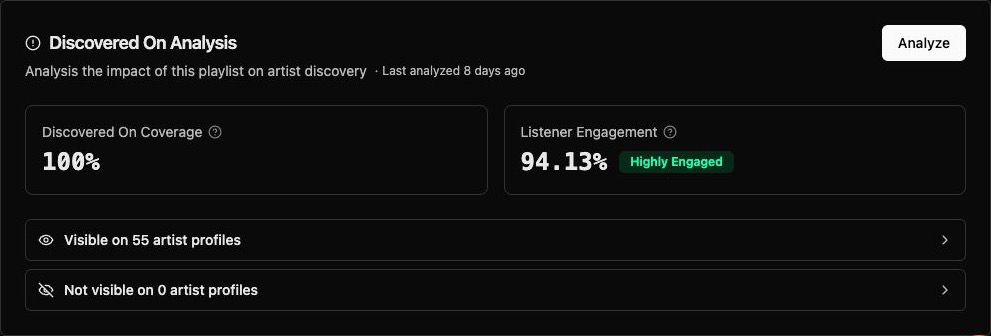
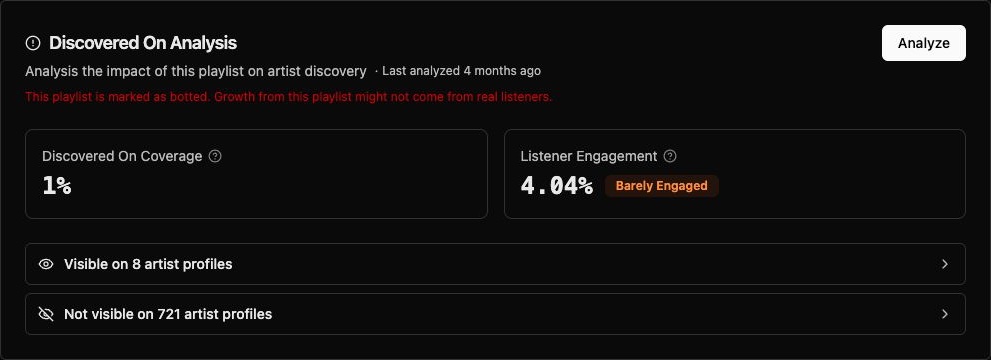
The healthy playlist showed 100% Discovered On coverage and 94.13% listener engagement. The other showed 1% and 4.04%. Its follower count had stopped moving. Its newest track was seven years old. artist.tools marked it "Likely Botted (Abandoned)".
We also checked four aggressively search-optimized house playlists: fire emoji, Ibiza keywords, party language, the lot. All four came back "Likely Bot-free". So the emoji test can go in the bin.
You cannot tell from the name. You can tell from four numbers, and they take about a minute to read.
This is where most red-flag lists run out of road. They train your nose, but your nose is judging artwork, emoji and follower counts. A real curator can have ugly artwork. A fake playlist can look gorgeous. Data is less charming, which is exactly why it is useful.
Source: Spotify for Artists, “Artificial streaming and paid 3rd-party services that guarantee streams” (checked 14 August 2026)
The check, timed
We ran this against both reports with a timer going. Five steps, about a minute, no login and no paid plan. We used the free Spotify Bot Checker at artist.tools. Chartmetric, SpotOnTrack and isitagoodplaylist offer similar checks, although the names and free limits differ.
- 0:00 to 0:10. Paste the playlist in. Copy the Spotify link, or just type the playlist name into the checker's search box. The report loads in a couple of seconds.
- 0:10 to 0:25. Read the reach, not the followers. Two fields matter here. Discovered On coverage checks how often the playlist appears on the artists' Spotify “Discovered on” sections. Listener engagement estimates whether the following actually listens. On the clean playlist those read 100% and 94.13%. On the flagged one they read 1% and 4.04%.
- 0:25 to 0:40. Look at the follower line. Steady movement is healthier than a dead-flat graph. A sudden vertical jump deserves investigation, but it is not proof by itself; a viral moment can create a real spike too. The flagged playlist reads “Flat at 1,478” with zero new followers a day.
- 0:40 to 0:50. Find the last track added. This one takes two seconds and it is brutal. The clean playlist added a track about one week ago. The flagged one last added a track seven years ago.
- 0:50 to 1:00. Look for a human. Is there a description? A contact? A name attached to a person who exists somewhere else on the internet? The clean playlist has a written description and an Instagram on file. The flagged one has an empty description and no contact at all.
Playlist Push makes the same core point in its own guide, and it is right: follower count matters far less than evidence of real listeners.
Source: Playlist Push, “How to Spot Bot Playlists on Spotify Before It's Too Late” (checked 14 August 2026)
The two reports, side by side
Both playlists are real. We rechecked them on 14 August 2026 in the same free tool, on the same fields. The screenshots hide the playlist and curator names but leave the actual test results untouched.
| What the report shows | Clean playlist | Flagged playlist |
|---|---|---|
| Verdict | Likely Bot-free | Likely Botted (Abandoned) |
| Followers | 7,960,901 | 1,478 |
| Followers gained per day | +1,752 | 0 (flat) |
| Discovered On coverage | 100% | 1% |
| Listener engagement | 94.13% (Highly Engaged) | 4.04% (Barely Engaged) |
| Total tracks | 150 | 1,155 |
| Unique artists | 55 | 790 |
| Last track added | about 1 week ago | 7 years ago |
| Track changes in 30 days | 11 added, 11 removed | none |
| Description written | yes | no |
| Curator contact listed | none |
Source: artist.tools free Spotify Bot Checker, both playlists rechecked 14 August 2026. The tool labels its assessment as opinion, not certainty. Treat the verdict as a screening signal, not a courtroom ruling.
We are not publishing either playlist's name or the flagged curator's name. One tool's opinion is a good reason to walk away. It is not enough to publicly accuse a real person. Run the check on the playlist in front of you. That is the useful version anyway.
The ratio almost nobody checks
Divide total tracks by unique artists. It takes five seconds and it tells you what kind of thing you are looking at.
150 tracks across 55 artists looks like somebody choosing. 1,155 tracks across 790 artists looks more like storage than a tight selection. That does not prove fraud. It does tell you to stop being impressed by the follower number and inspect the rest.
Worth being fair here: Playlist Push's guide flags playlists with under 40 tracks as suspicious, which is a useful question at the other end of the scale. The count alone decides nothing. The ratio, plus the date of the last add, is what turned this report from “maybe” into “why would you send your track here?”
It is not the money that should worry you. It is what Spotify does to the track.
Most people vet a playlist because they do not want to waste a submission fee. Fair enough. The bigger cost is on the other side.
Spotify says confirmed artificial streams can lose royalties, disappear from public numbers and fail to help recommendation systems. Depending on severity, Spotify may also remove the song from playlists. Distributors can issue warnings, suspend an account or remove content in repeated or serious cases.
Spotify also charges labels and distributors per track when it detects very high rates of artificial streaming. Whether your distributor absorbs that cost or passes it on is between you and the distributor. Either way, the bargain-bin stream package just became expensive.
The clean rule is simple: guaranteed streams are not legitimate, and guaranteed paid placement violates Spotify's terms. Real curation includes the possibility of a no.
Source: Spotify for Artists, “Artificial streaming and paid 3rd-party services that guarantee streams” (checked 14 August 2026)
That is the ban question, and it deserves its own article rather than a paragraph. So does the separate question of a placement that is honest but simply wrong for your record, which can stall a release in a quieter way that nothing here will catch.
It failed the check. Now what?
If you have not sent anything yet, this is easy. Walk away and say nothing. You do not owe a stranger an explanation, and a curator who pushes back on being checked has told you everything.
If your track is already on it, you cannot take it off yourself. Three steps, in this order:
- Report it to Spotify. Spotify for Artists lets you report suspicious playlists your music has been added to. Do this first, because it puts your side of the story on the record before anything gets flagged.
- Ask the curator to remove it. Short and polite. Many of these accounts do list an email somewhere.
- Keep every message. If your distributor asks about artificial streaming later, you can show that you spotted the problem and acted.
There is a longer emergency walk-through for the case where your streams have already been hit. It is a separate article on this site.
What this check cannot tell you
Three honest limits, because a checklist that pretends to be certain is its own kind of scam.
Bots move. Every detection tool is reading yesterday's patterns. A farm that changes how it buys followers can look clean for a while. artist.tools says so itself beside the green badge.
"Abandoned" is not the same as "dangerous". The flagged playlist in this article carries a note saying it "appears to be abandoned and likely poses little to no risk". A dead playlist with fake followers from 2017 will probably do nothing to you at all. It also will not do anything for you, which is reason enough to skip it.
A clean verdict is not a good placement. This whole check answers one question: is this playlist real? It says nothing about whether its listeners want your record. A real playlist with the wrong crowd is the more common way to waste a release, and no bot checker will ever warn you about it.
Are you a house producer looking for a Spotify playlist network run by people who can tell deep house from “EDM vibes”?
Sixty seconds. Four numbers. Do it before you send the track, not after somebody else has decided what your music is worth.